
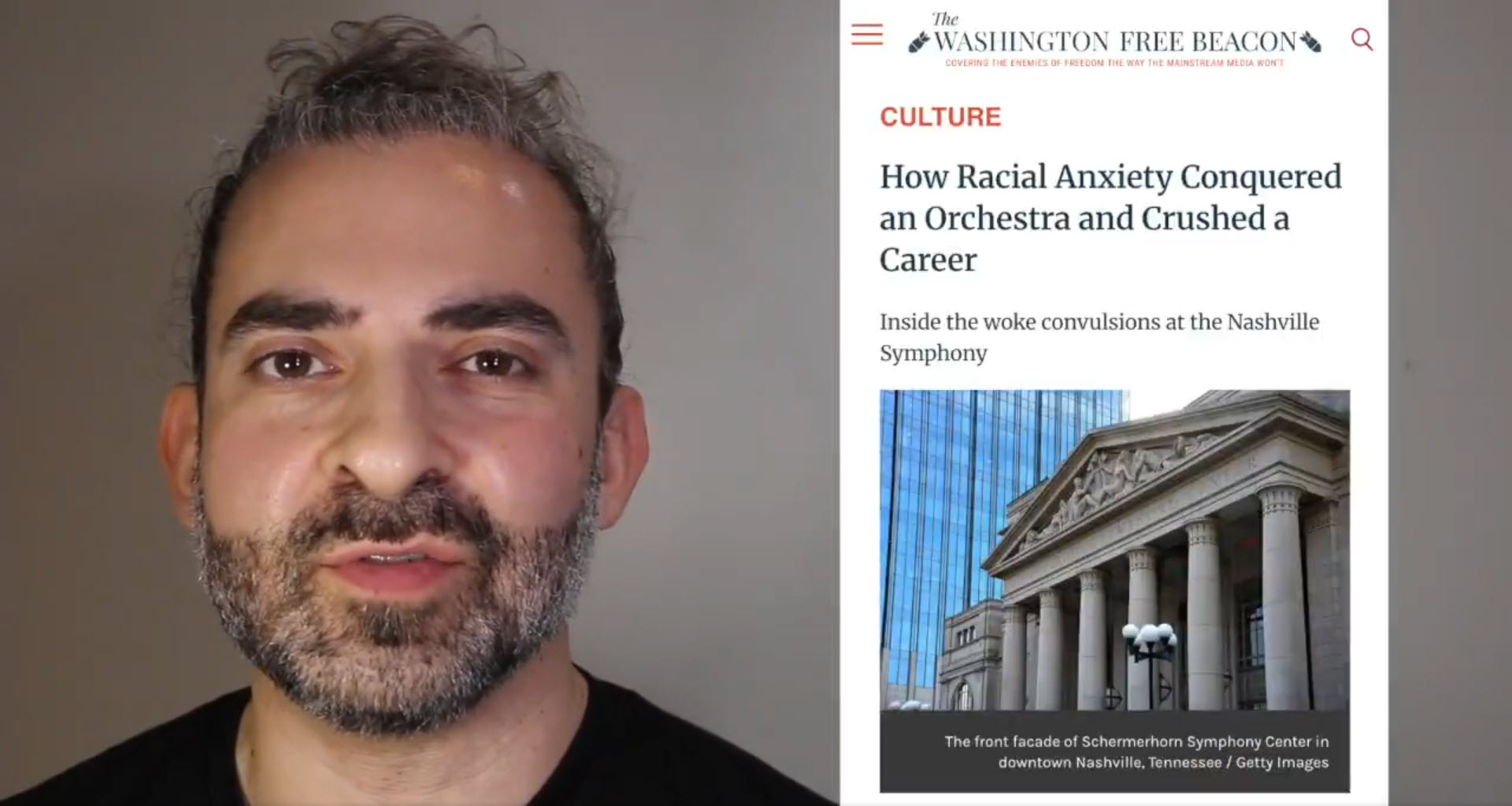
A professional clarinetist is suing the Knoxville Symphony Orchestra after winning his audition, yet not being hired over “Diversity, Equity & Inclusion” (DEI) concerns.
James Zimmermann has the necessary qualifications. He was previously the principal clarinetist of the Nashville Symphony for 12 years. He has been recorded on the soundtracks of various films and video games. By all accounts, he’s a fantastic musician.
So it’s not surprising when he auditioned for the Principal Clarinet position at Knoxville, he won the blind audition. The trouble began only after his identity was revealed to the KSO leadership — two days later, their CEO, Rachel Ford, informed Mr. Zimmermann they would not be hiring him after all. The reason? Zimmermann had resisted DEI efforts at his previous post in Nashville. For that, Knoxville wouldn’t touch him.
BLACKLISTED: In September the Knoxville Symphony invited me to their blind audition for Principal Clarinet, which I won by unanimous vote. Two days later their CEO called and refused to hire me, citing my ousting from the Nashville Symphony six years ago for resisting DEI as the… pic.twitter.com/fmM0B9Lzl1
— slimzim (@jameszimmermann) January 5, 2026
The irony of the Nashville incident is that Zimmermann got in trouble for defending the blind audition process, which has actually increased diversity in many orchestras.
New York Times music critic Anthony Tommasini has recently argued against blind auditions, calling for their end. While Tommasini admits that blind auditions have done much to increase diversity of race and gender, he claims that is still “not enough.” While he can’t quite bring himself to say it out loud, Tommasini seems to imply the solution is hiring musicians primarily based on their race, not their musicianship.
Of course, discriminating based on one’s skin color — no matter what it is — is just as wrong now as it was 100 years ago. Max Raimi of the Chicago Symphony has made a brilliant rebuttal to the NY Times piece, as has Nicholas Finch of the Louisville Orchestra. Hiring the best musicians, regardless of their race, gender, religion, or other immutable characteristics, is the only fair way to go.
If one is concerned about the lack of “diverse” classical musicians, perhaps a better approach would be to increase access and opportunities for kids to take music lessons from an early age. If there are more diverse students in the pipeline, the makeup of orchestras will ultimately change as well. Indeed, there are groups such as the Sphinx Organization working towards this end.
Regardless, music should not be politicized. Nor should it be a virtue-signaling contest. Music is supposed to speak directly to the human soul, no matter who you are or what you look like. Good music is equally capable of moving us to tears, as to the heights of joy. Orchestras should focus on attracting the best musicians who can do just that.
For this reason we hope Mr. Zimmermann is successful in his case. We hope the Knoxville Symphony (and any other orchestras currently affected by this madness) fix their priorities and get back to the music.











Whatever one’s views on DEI, it’s hard to justify denying a position to a musician who won a blind audition by unanimous vote based on his past political stances rather than his musicianship. Mr. Zimmermann deserves his day in court.