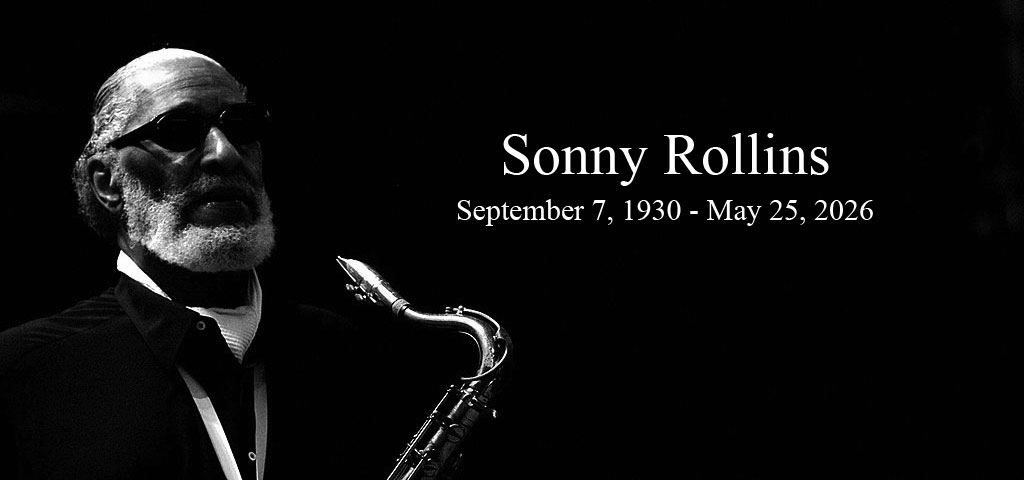
American jazz saxophonist Sonny Rollins’ incredible life came to an end last week, May 25th, passing away at his home in Woodstock, New York. He was 95 years old.
He was born Walter Theodore Rollins on September 7, 1930, in Harlem, New York City. Rollins grew up in a musical family and was nicknamed “Sonny” by his grandmother. His musical journey began with playing the piano at the age of nine, and later on he switched over to the saxophone.
Once he graduated from high school in 1948, Rollins began performing professionally and soon established himself as a rising star of the bebop movement. During the early 1950s, he recorded with many of the greatest musicians of that time. These included Miles Davis, Charlie Parker, and Thelonious Monk — to name just a few.
Rollins was inspired by Coleman Hawkins and mentored by Thelonious Monk. He grew into one of the most gifted young musicians of his generation.
In 1954, he had a major breakthrough when he composed and recorded “Oleo,” “Airegin,” and “Doxy” with Miles Davis. All of these compositions would become jazz standards. He sadly battled with a heroin addiction, for a time. However, he succeeded in conquering the addiction, and went on to join the Clifford Brown–Max Roach Quintet. He then began a remarkable run of recordings under his own name.
Widely regarded as one of the greatest jazz albums ever recorded, Rollins released Saxophone Colossus in 1956. The album went on to feature his signature composition “St. Thomas,” a piece that was calypso-inspired, reflecting his Caribbean heritage, and became one of the most recognizable tunes in jazz history.
Rollins continued to innovate, pioneering the use of saxophone, bass, and drums trios without a piano. In the late 1950s, he released albums such as Way Out West, A Night at the Village Vanguard, and Freedom Suite, which showcased his extraordinary improvisational ability and willingness to challenge musical conventions.
At the peak of his successful career, Rollins stepped away from performing in 1959. This came as quite a shock to the jazz world. He was dissatisfied with his own playing. So, he spent almost three years practicing extensively on New York City’s Williamsburg Bridge. In 1962, he returned with the acclaimed album The Bridge. This album became one of the defining recordings of his career.
Through the decades, Rollins remained truly one of jazz’s most adventurous artists. He explored many genres, from avant-garde jazz and Latin rhythms, to funk and R&B.
In 1969, Rollins took a second break from performing live, deciding to study yoga, meditation, and Eastern philosophy. He then returned to the stage in 1971.
Rollins had become one of jazz’s most celebrated elder statesmen by the 1980s. He was named a Jazz Master by the National Endowment for the Arts. He would go on to appear on recordings by The Rolling Stones. While doing all this, he continued performing for audiences around the world. In 1995, in his honor, November 13 was declared “Sonny Rollins Day” by the City of New York.
In 2011, President Barack Obama praised Rollins for inspiring others to take risks and push creative boundaries. Among his long list of accolades were a Grammy Lifetime Achievement Award, the National Medal of Arts, and the Kennedy Center Honors.
Rollins experienced recurring respiratory issues caused by pulmonary fibrosis, which unfortunately forced him to retire from public performance in 2014. Despite this, he continued to be an enduring presence in the jazz world. His personal archives were donated to the Schomburg Center for Research in Black Culture. In 2024, his notebooks were published — offering insight into the mind of one of jazz’s most brilliant innovators.
In a career spanning more than seven decades, Rollins recorded more than sixty albums. Often called the “Saxophone Colossus” and “the greatest living improviser,” he is widely regarded as one of the most influential and impactful musicians in jazz history.
Rest In Peace, Sonny Rollins.